But being Net Zero in 2050 might not be sufficient. CO₂ accumulates in the atmosphere with warming effects that persist long after the moment of emission. The sooner emissions are reduced, the better our chance of staying within the 2°C ceiling set out in the Paris Climate Agreement.
The Opportunity Others Overlook
Addressing system inefficiencies has been a staple of every net-zero roadmap. It is often dismissed as marginal, typically accounting for only 3–6% of the total reduction needed. But while SAF scaling and hydrogen-fuelled aircraft grapple with technical and commercial barriers that will take years to overcome, addressing operational deficiencies can be done now. And as argued above, avoiding CO₂ entering the atmosphere today is more valuable than avoiding the same ton ten years from now.
Within our field of expertise, we know that capacity-constrained airports combined with the multi-stakeholder complexity of ANSPs, airports, airlines, ground handlers, and terminal processes are driving both congestion and inefficiency. The industry has increasingly moved towards holistic approaches, after A-CDM we now see Airport Operations Plans (AOPs) and Airport Operations Centres (APOCs) connecting terminal and turnaround operations. Yet the gap between optimum and reality persists.
The Data Confirms the Gap
A recent gap analysis by independent aviation consultancy To70, using one week of actual ADS-B traffic data at Amsterdam Airport Schiphol against a fast-time simulation of the same traffic under ideal conditions, makes this concrete. The findings were unambiguous: departures carry the most potential for improvement, especially at the pushback and apron phase.¹
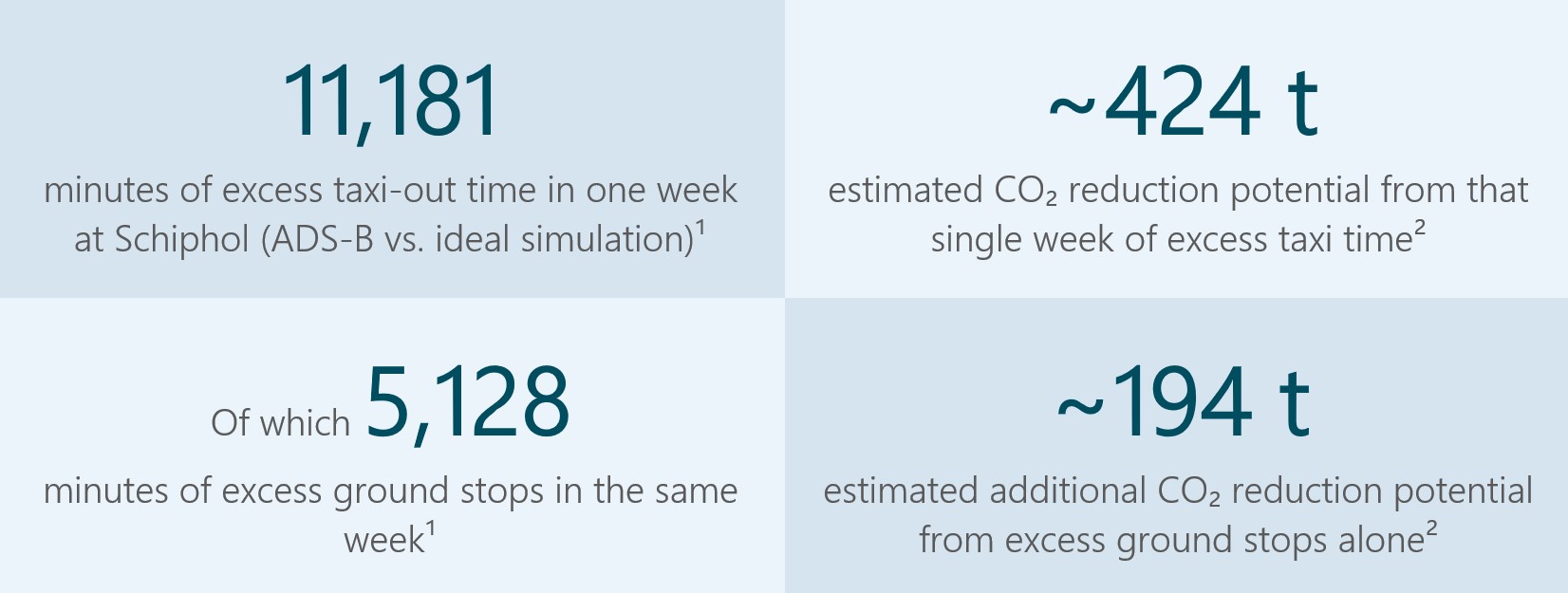
¹To70 / ADB SAFEGATE, ‘Airport Performance Use Case Gap Analysis – EHAM’ (2026). ²Calculated at 12 kg/min (Air France/SESAR: “Taxiing uses 10–13 kg fuel per minute for A320 family”, Giuseppe Pillirone, Air France) × 3.16 kg CO₂/kg fuel (ICAO/CAEP, EUROCONTROL Standard Inputs).
Across the sample period, the simulation predicted 11,181 minutes less taxi time than measured through the ADS-B data. 5,128 minutes may be attributed to ground delays; the simulation achieved 8,995 minutes of total ground delay versus 14,123 minutes in actual operations, a 36% gap. The map below shows where ground delay accumulated in the actual operation versus the simulation. Ground stops are concentrated around the apron, indicative of a persistent mismatch between pushback clearance and actual take-off capacity.
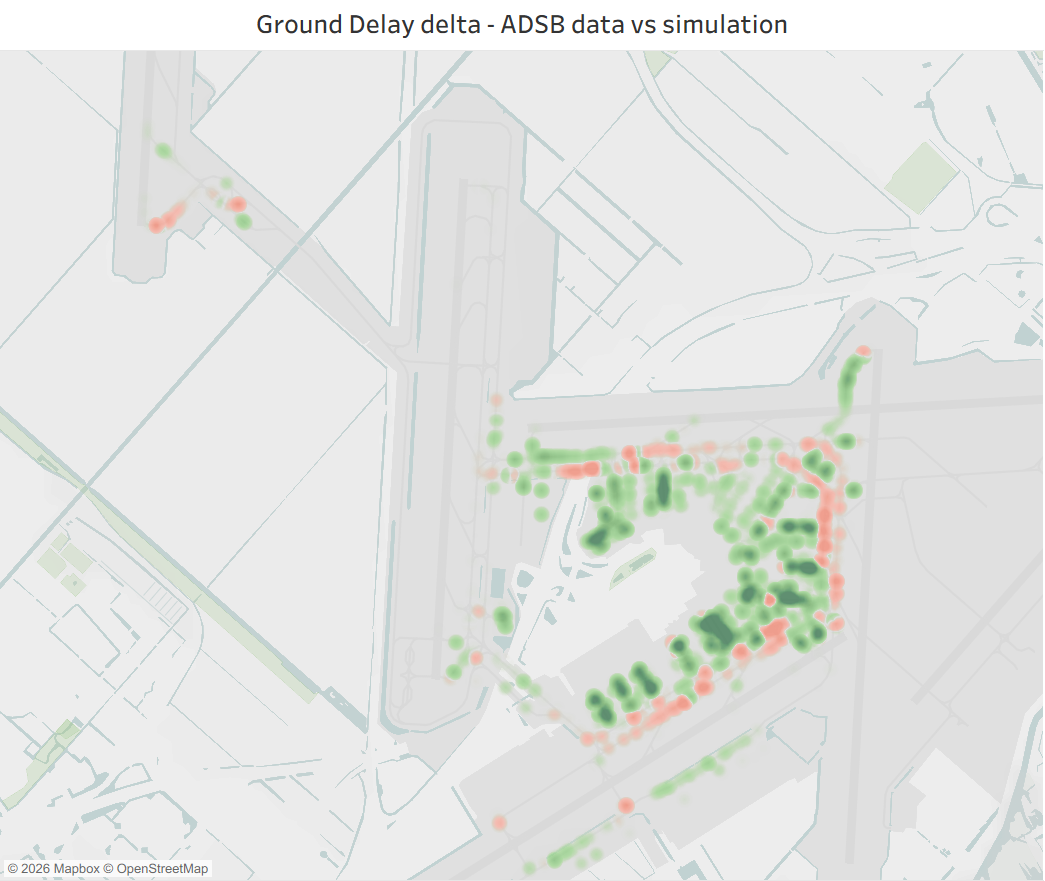
Figure 1: Ground delay delta – ADS-B actual operation vs. simulation (To70 / ADB SAFEGATE, 2026). Green = less delay in simulation. Red = more delay in simulation.
“The departures have the most potential for improvement — especially regarding pushback and apron operations.”
— To70 Aviation Consultants, EHAM Gap Analysis, 2026
From Apron to Runway: How Adaptive Airfield Lighting Closes the Gap
Data shows a persistent gap between turnaround, routing, guidance, and departure, even with ongoing optimization. Closing that gap from pushback to take-off is key to easing peak-hour capacity constraints and cutting avoidable emissions. Adaptive Airfield Lighting (ADAL) could provide that end-to-end continuity, from apron conflict resolution and pushback support to advanced Follow the Greens and dynamic taxiway holding, without major infrastructure changes.
Pushback and docking support. Switching apron taxiway centreline lights from green to red during pushbacks and docking procedures resolves conflicts and assists in the orchestration of the apron area. By integrating pushback status into routing and actively resolving conflicts in real time, ADAL directly targets the stand delay and ground stop inefficiencies.
Advanced Follow the Greens. Smooth traffic flow is essential for departure efficiency. A controller is always carefully balancing optimized runway capacity against short, efficient taxi flows while maintaining safe separation. Routing and guidance tooling provides a sound base, and adaptive lighting elevates the guidance layer. The illuminated path advances ahead of the aircraft and extinguishes behind it, and its length can be adjusted to signal speed changes, removing stop-and-go behavior that drives disproportionate fuel burn at low thrust settings. Routes that cannot be entered are switched to red, eliminating ambiguity.
Dynamic Holding Positions. Rather than fixed intermediate holding position lights, each requiring dedicated CCRs, circuits, and primary cabling, ADAL enables holding positions to be created and dissolved dynamically in software, anywhere within the system. Being able to halt or separate aircraft at any point on the taxiway, rather than only at fixed positions, has the potential to greatly improve taxi-out flow.
Conflict protection. Additional automated safety nets, for both pushback and docking, and during taxiing, maintain safety standards without sacrificing throughput. Detected conflicts are autonomously resolved with clear visual cues by giving way in green and initiating a stop in red.
Sustainable by Design: Less Infrastructure, More Capability
Adaptive lighting has the potential to greatly improve routing efficiency without drastically altering an airport’s infrastructure. As a dual-function light, ADAL requires no more installed infrastructure than the existing taxi lighting system. It is retrofittable on existing circuits through LINC 360’s powerline communication technology; no new primary cabling is required.
Conventional systems would require additional lights, circuits, communication cabling, and power equipment to deliver a fraction of the flexibility that adaptive lighting provides. With adaptive lighting, an airport reuses what is already there:
- Fewer total fixtures to achieve the same, or greater, functional coverage.
- Fewer electronics and less raw material, reducing the embodied carbon of the installation.
- Dynamic Holding Positions deployable in software, eliminating the need for additional CCRs, circuits, and primary cabling entirely.
The result is lower lifecycle costs and a significantly more flexible, future-proof setup, achieved by making smarter use of what is already in the ground.
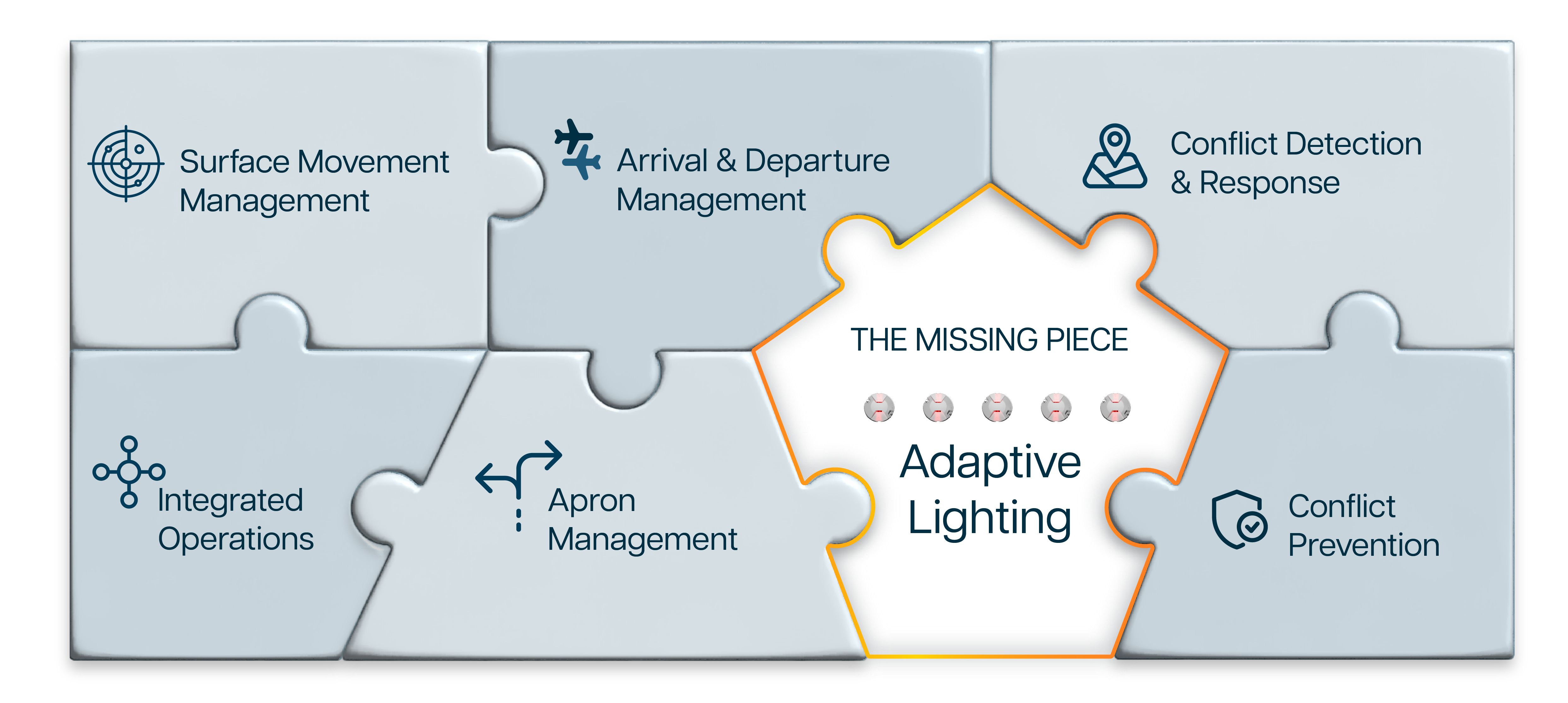
Completing the Ground Movement Puzzle
The To70 study shows that the gap between pushback and take-off persists, even at one of Europe’s most advanced, data-rich airports. While stakeholders are increasingly linked through shared processes and integrated systems, turning that coordination into smooth and safe surface movement execution still falls short. Adaptive airfield lighting may be the missing piece that closes that final gap.
References
- To70 / ADB SAFEGATE, ‘ADB SAFEGATE Airport Performance Use Case Gap Analysis – EHAM ADS-B Data vs Simulation Results’ (2026). Based on 9 days / 10,523 flights at Amsterdam Airport Schiphol.
- CO₂ estimate: excess minutes × 12 kg fuel/min × 3.16 kg CO₂/kg fuel. Fuel flow sourced from Air France/SESAR webinar (Giuseppe Pillirone, Air France): “Taxiing uses 10–13 kg fuel per minute for A320 family” — https://www.sesarju.eu/sites/default/files/documents/webinars/Guiseppe.pdf. CO₂ conversion factor 3.16 g CO₂/g Jet-A: ICAO/CAEP recommendation (ICAO Doc 9889), cited in EUROCONTROL Standard Inputs for Economic Analyses — https://ansperformance.eu/economics/cba/standard-inputs/latest/chapters/amount_of_emissions_released_by_fuel_burn.html
- ADB SAFEGATE, ‘Leading the Charge in Sustainable Airfield Solutions’ (2024).