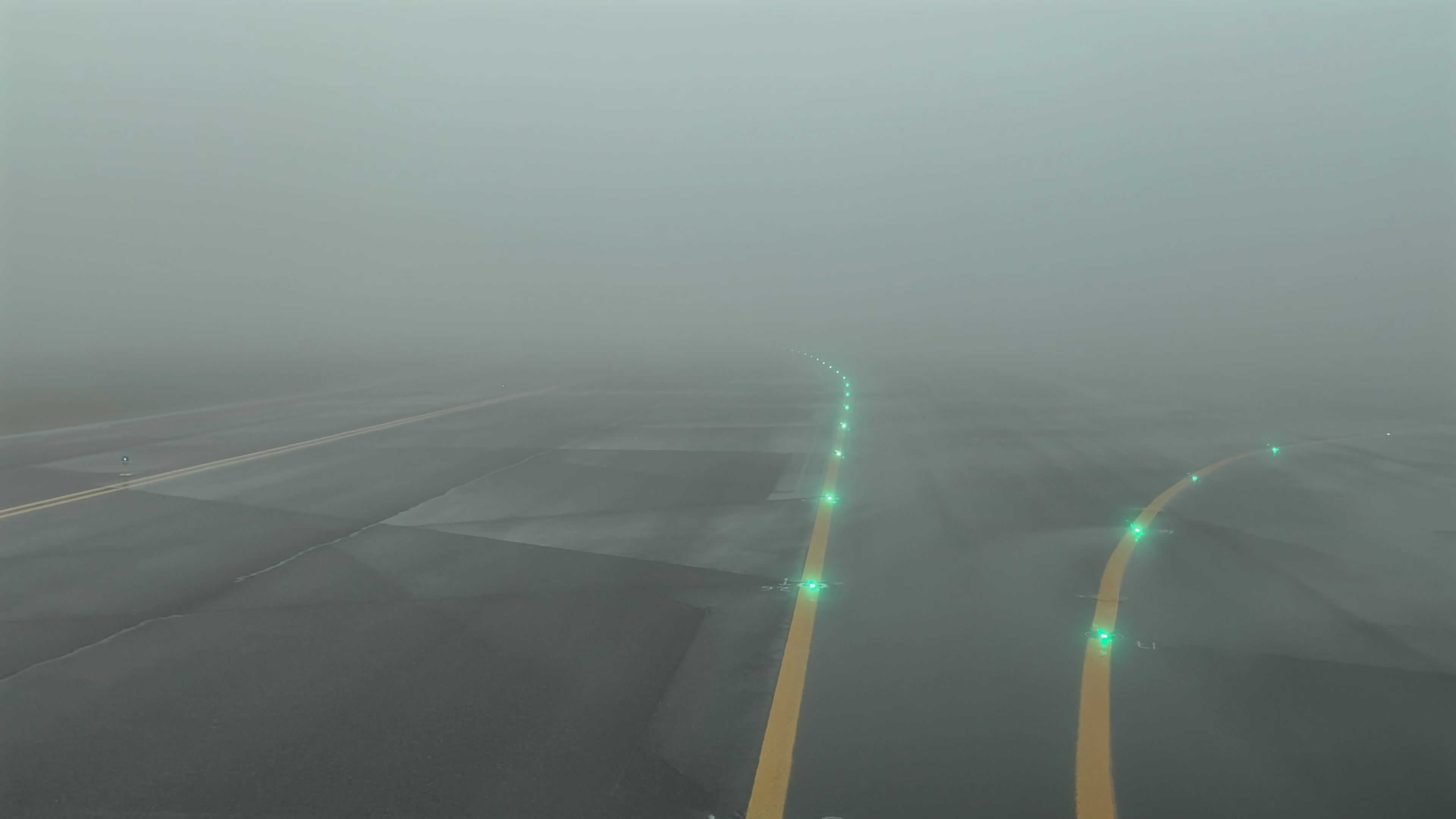
To be clear, FTG is not new; it has been successfully deployed at airports and has proven its value in a wide range of operational scenarios. It works, it delivers benefits, and it represents a significant step forward compared to traditional taxi instructions. But like many good concepts, its real limitations only become visible in the most demanding environments.
Where Traditional FTG Reaches Its Limits
Earlier implementations of FTG were designed to cover a broad range of situations, and they do so well. However, they struggle when confronted with conditions often faced at large hub airports:
- Highly complex taxiway layouts
- Non-standard intersections (far from 90° geometry)
- High-density traffic environments
- Multiple aircraft operating in close proximity
One of the fundamental challenges lies in the installation of taxiway centerline lights (TCLs). They aren’t continuous lines, and guidance comes from individual, widely spaced fixtures rather than a solid visual path. That spacing can introduce ambiguity when conveying precise instructions, especially in tight geometry, complex intersections, or congested areas.
Another limitation becomes evident at runway holding points, where traffic density is highest. Here, multiple aircraft movements converge, and the system must clearly indicate who stops and who continues. Traditional FTG relies heavily on switching lights off to indicate a stop, but “OFF” is not always a sufficiently clear or intuitive signal. Add to this the challenge of intersections with acute angles, where it becomes difficult to assign one unambiguous light path to each aircraft, and the limitations become clear: the concept works, but not optimally in all scenarios.
The ADB SAFEGATE Step Forward
This is where ADB SAFEGATE’s Follow the Greens solution marks a decisive step forward. It doesn’t reinvent FTG – it finishes it, closing the operational gaps that have kept the concept from reaching its full potential. A key differentiator of ADB SAFEGATE’s solution is its full integration into CORTEX OneControl. It runs seamlessly in the existing tower environment and is fully automated in the background:
- No additional inputs from anyone
- No extra coordination steps with any other system
- No increase in controller workload
Controllers remain fully in the loop. The system is transparent, predictable, and aligned with the controller's intent, supporting the operation without competing for the attention of the user. That balance of automation without losing situational awareness is what makes it workable in real-world conditions.
Clear and Explicit Guidance Anywhere
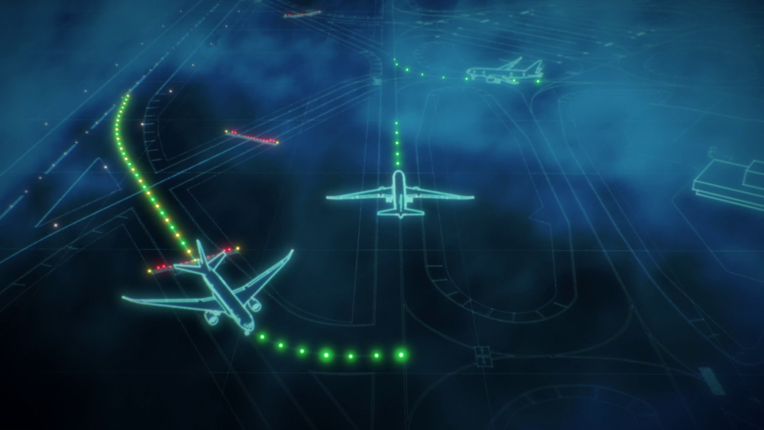
One of the most important improvements is the introduction of adaptive airfield lighting (ADAL), which resolved one of the most critical weaknesses of earlier FTG implementations. Instead of relying solely on lights being switched off, ADB SAFEGATE’s ADAL enables switching lights from green to red to provide clear and explicit STOP indications, independent of traditional stop bars. This means:
- STOP instructions are visible, intuitive, and unambiguous
- They can be placed anywhere on the taxiway
- They are no longer constrained by infrastructure layout
CORTEX OneControl goes a step further, integrating the aircraft push process as part of the standard routing and guidance. When the aircraft has received push clearance, ADALs autonomously visualize the end of the push path and the end of the pull path.
Dynamic Light Horizon – Stable and Intuitive Guidance
Another breakthrough is the concept of the dynamic light horizon. Rather than requiring occasional switching of lights on and off, which can become confusing in dense environments, the system uses an intelligent algorithm to dynamically adjust the taxi length of illuminated green centerline lights.
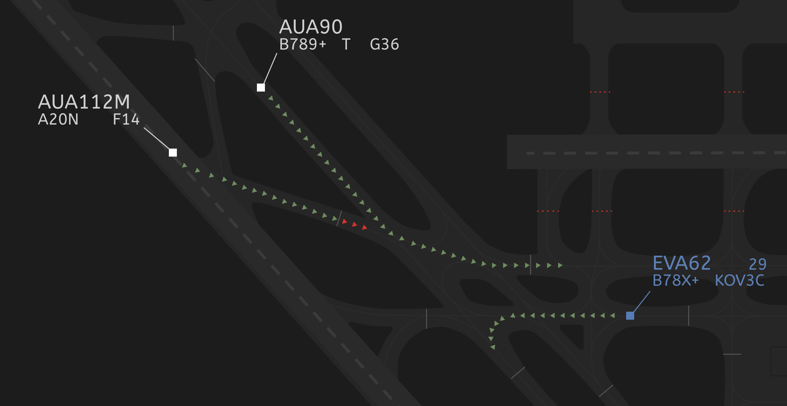
Until now, ON – OFF switching situations have mainly been avoided by having a short distance ahead of an aircraft movement switched ON, which is not ideal. Now the guidance always extends to the next relevant decision point, typically the next turn. This results in:
- Reduced ON/OFF switching
- More stable visual guidance
- Lower cognitive load for pilots
All Movements, All Conditions
ADB SAFEGATE’s Follow the Greens solution is built for the environments where ground movement risk and delay are hardest to manage, like complex airfield layouts, dense traffic, and mixed aircraft & vehicle operations. Fully integrated into CORTEX OneControl, it uses real-time surface surveillance awareness driven by the ADB SAFEGATE SDF++ to detect conflicts, resolve them automatically, and prevent them predictively – supporting smooth flow even at high-pressure points like runway holding point areas.
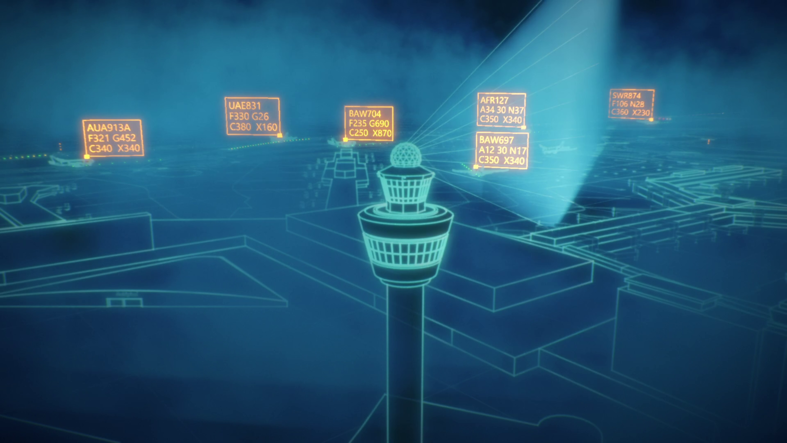
Designed for continuous operation in all weather conditions, including low visibility environments where visual guidance becomes even more critical. The same guidance framework is not limited to aircraft; it supports airport vehicles, including towing operations, service vehicles, and maintenance traffic, creating a consistent surface “language” across the airside without adding steps or workload for controllers.
Conclusion
This isn’t FTG as a concept. It’s FTG brought to operational maturity – predictive, adaptive, and tower-integrated. With this, ADB SAFEGATE sets a new benchmark for Follow the Greens: safer surface movements, smoother flow, and simpler execution – ready for real-world operations now.