These static positions have served aviation well for decades since traffic volumes and operational complexity have been manageable. Nowadays, and considering expected traffic growth across the globe, high-density airports will be facing increasing pressure from growing demand, tighter schedules, together with the need to minimize environmental impact.
In this evolving landscape, static holding positions can become bottlenecks rather than safeguards, limiting the ability of airport stakeholders to adapt dynamically to these real-time conditions. In response to this challenge, the concept of Dynamic Holding Positions (DHP) emerges as a transformative solution, enabling holding positions tailored to a dynamic operational context.
Limitations of static intermediate holding positions in complex and busy airfields
Consider a typical peak-hour scenario at a busy international airport. Departing aircraft queue along taxiways, often stopping a intermediate holding positions while awaiting clearance to proceed toward the runway. Meanwhile, arriving aircraft must navigate through the same complex airfield layouts, sometimes encountering congestion that leads to delays, increased fuel burns, and elevated workload for both pilots and air traffic controllers.
The intermediate holding positions at the airfield, although strategically planned and based on proper airport planning, are fixed in location and do not account for the multiple and evolving aircraft types, taxi speeds, runway occupancy times, new routes, or evolving traffic sequences.
As a result, aircraft may be held either too early, creating unnecessary congestion, or too late, risking safety margins or last-minute braking. The lack of flexibility in this system can lead to inefficiencies across the entire operation, affecting not only punctuality but also safety margins, particularly in complex airfield layouts or low visibility conditions.
The role of Dynamic Holding Positions: A smart alternative to redefine airfield movement
The transition from fixed intermediate holding positions to Dynamic Holding Positions represents a shift from static, infrastructure-based control toward a more adaptive and data-driven model for airfield operations management. Rather than relying on predefined physical locations marked by signage and lighting, dynamic holding positions allow these ones to be determined in real time based on actual operational context. This dynamic approach ensures that separation is maintained, and therefore safety, while optimizing the flow of movements, especially in complex and congested airfield environments.
Alternative control mechanisms, particularly the usage of stop bars at these intermediate holding positions to control aircraft movements, are not an optimal replacement. While stop bars provide clear visual and procedural means of controlling aircraft movements, their deployment across taxiway networks introduces significant challenges. From an airport infrastructure perspective, installing and maintaining stop bars requires substantial investment in lighting systems, power supply, monitoring capabilities and control interfaces, especially if extended to multiple intermediate positions, which increases capital and operational costs. In contrast, our Adaptive Airfield Lighting (ADAL) solution can be installed at the same position as intermediate holding position lights.
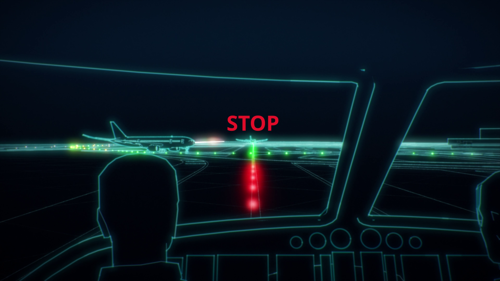
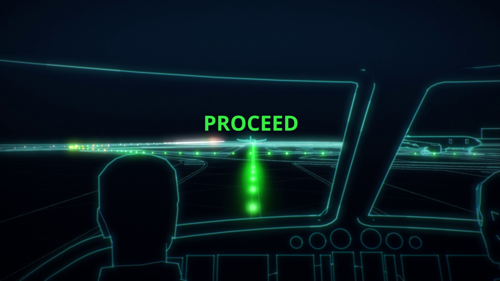
In practical terms, the implementation of dynamic holding positions transforms how aircraft are sequenced and managed across the airfield. Instead of instructing pilots to stop at fixed intermediate positions (or relying on multiple stop bars), controllers can issue flexible taxi clearances that adapt to real-changing conditions. An aircraft may be allowed to proceed further along its taxi route before holding, reducing congestion and improving taxiway utilization, while another may be held earlier to prevent downstream conflicts.
This dynamic allocation reduces unnecessary stop-and-go movements, shortens taxi times, and lowers fuel consumption and emissions. At the same time, safety is enhanced by enabling more strategic positioning of aircraft, reducing the risk of conflicts. Ultimately, this strategy offers a balanced solution that improves efficiency and safety while avoiding increased controller workload with expanding stop bar-based control, and without requiring significant new infrastructure adding stop bars.
Why Dynamic Holding Positions are a logical evolution
Although dynamic holding positions are not yet widely formalized as a standalone concept, they are strongly supported by existing studies; for example, a 2025 study in the “Journal of Air Transport Management” proposes “a dynamic control method for airport ground movement optimization, addressing the taxiing uncertainty of mega airports through the adaptive traffic situation and updated conflict priority design.”
In addition, EUROCONTROL already mentions, “If there are no green (or alternating green and yellow); or if there are activated red TCL or there is a stop bar, then they must stop the aircraft”1. Based on this specification, red taxiway centerline lights are an unambiguous stop indication for pilots.
Dynamic Holding Positions: Efficiency, Safety, and Savings Combined
Dynamic Holding Positions mark a transformative step forward in airfield operations management, enabling airports to respond flexibly to real-time traffic and operational demands while maintaining the highest standards of safety and efficiency.
Unlike traditional approaches that rely on static infrastructure or the widespread installation of stop bars (a costly, complex, and resource-intensive option), dynamic holding positions leverage ADAL and data-driven control to optimize aircraft sequencing and reduce congestion. This approach not only streamlines ground movements and lowers emissions, but it is also a practical and scalable solution for airports facing increasing traffic and capacity challenges in the coming years.
If you’d like to explore how this use case maps to your runway and taxiway layout and surveillance environment, contact ADB SAFEGATE to review a concept of operations and deployment approach for dynamic holding positions.
References
1. EUROCONTROL-SPEC-171 Specification for Advanced-Surface Movement Guidance and Control System (A-SMGCS) Services, section 4.3.4 Guidance Service