Airports have never lacked rules. What they’ve lacked, especially on taxiways and aprons where aircraft, buses, baggage tugs, fuel trucks, and maintenance vehicles all converge, is a way to make those rules instantly visible at the exact moment risk spikes.
That’s the safety gap that is changing with the arrival of a new generation of adaptive airfield lighting, turning real-time situational awareness into an unmistakable stop-or-go message where ground vehicle drivers need it most.
The Everyday Danger Hiding in Plain Sight
If runway incursions are the headline-grabbers, taxiway and apron conflicts are the slow-burn risk: frequent, complex, and often driven by human factors. Service roads cut across taxiways and apron routes because the airport must keep moving, and vehicles need access to stands, gates, and equipment areas. But those intersections create repeated conflict points where a driver may not see a taxiing aircraft in time, may misjudge speed or distance, or may assume the aircraft will stop.
The cost of getting it wrong is measured in more than ground collision repairs. A single stop-and-go disruption can cascade, slowing taxi flow, creating delays, missed departures, wasted fuel, and heightened exposure for everyone operating near aircraft.
EUROCONTROL’s work on airport surface safety nets frames this challenge bluntly: surface safety issues aren’t just runway problems. They extend across the movement area—including taxiways and apron/stand areas—and they’re closely tied to loss of situational awareness, communication breakdowns and timely alerting. In other words, airports need ways to spot a developing conflict early and deliver clear warnings to the people who can prevent it.¹
Airports need a way to make the “right action” unmistakable for vehicle drivers at the exact point of risk—and to do it consistently, without relying on manual intervention.
The Breakthrough: Turning Surveillance into a “Stop” Command Through Light
ADB SAFEGATE’s answer is an Automated Service Road Safety System that links aircraft movement data directly to a physical, unmistakable instruction at the crossing itself.
Here’s what makes it different: rather than relying on radio calls, signage, or human action, the system uses adaptive lighting to communicate in the universal language of driving—color and command. This evolves lighting as active safety infrastructure, reducing the need for manual coordination (including wing walkers), minimizing unnecessary stops, and helping maintain predictable and safe aircraft movement.
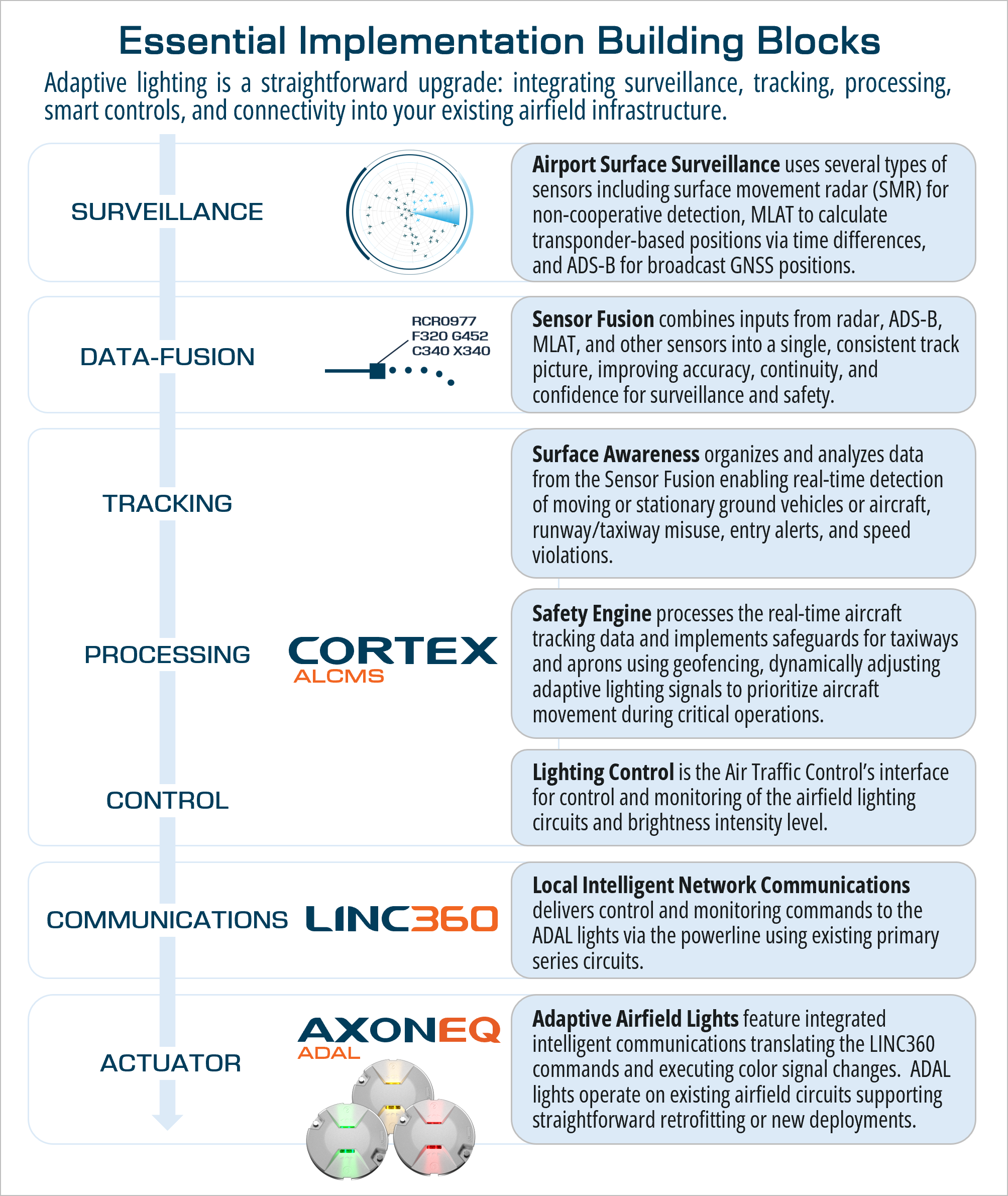
Refer to the ‘Essential Implementation Building Blocks’ diagram. The highlights of this approach are two key components:
- CORTEX ALCMS (Airfield Lighting Control and Monitoring System) handles the sensor fusion data, provides the safety engine that determines when an aircraft is approaching a service-road crossing, and then executes the control logic to change the lighting state to warn or stop service road vehicle traffic.
- AXON EQ ADAL is the “actuator” in the field—the hardware that turns that safety logic into an immediate, visible cue for drivers by dynamically changing light states:
- YELLOW = Caution / Warning
- RED = Stop / Hold
In other words: The CORTEX ALCMS can “decide,” but ADAL can act—in real time, at the point where the driver needs the instruction, automatically halting service-road traffic until the aircraft has passed.
Why This Matters: It reduces dependence on perfect human timing
Aviation safety has always balanced procedures with technology. Taxiways and aprons, however, still depend heavily on people being in the right place, with the right information, at the right time.
EUROCONTROL’s surface safety net concept reinforces the value of automation and alerting designed to prevent conflicts—and notably points out that alerting doesn’t always require cockpit or vehicle onboard equipment: airfield lighting can be used to provide direct indications to pilots and vehicle drivers.¹ That’s a crucial point. It means airports can deliver decisive instructions without requiring additional onboard equipment in every vehicle.
EUROCONTROL also discusses prevention-oriented visual barriers—such as steady red lights intended to prevent entry into protected areas (the same principle behind stop-bar operations).¹ The industry direction is clear: airports are moving toward integrated surveillance + automated alerting + direct visual guidance to reduce human error and increase time available to resolve hazardous situations. The Automated Service Road Safety System applies that proven logic at one of the most common taxiway and apron conflict points—service road interactions with aircraft taxiing or docking at a stand.
The Technology Behind the Headline: A Light Designed to Adapt
AXON EQ ADAL’s is designed specifically for adaptive, multi-signal applications:
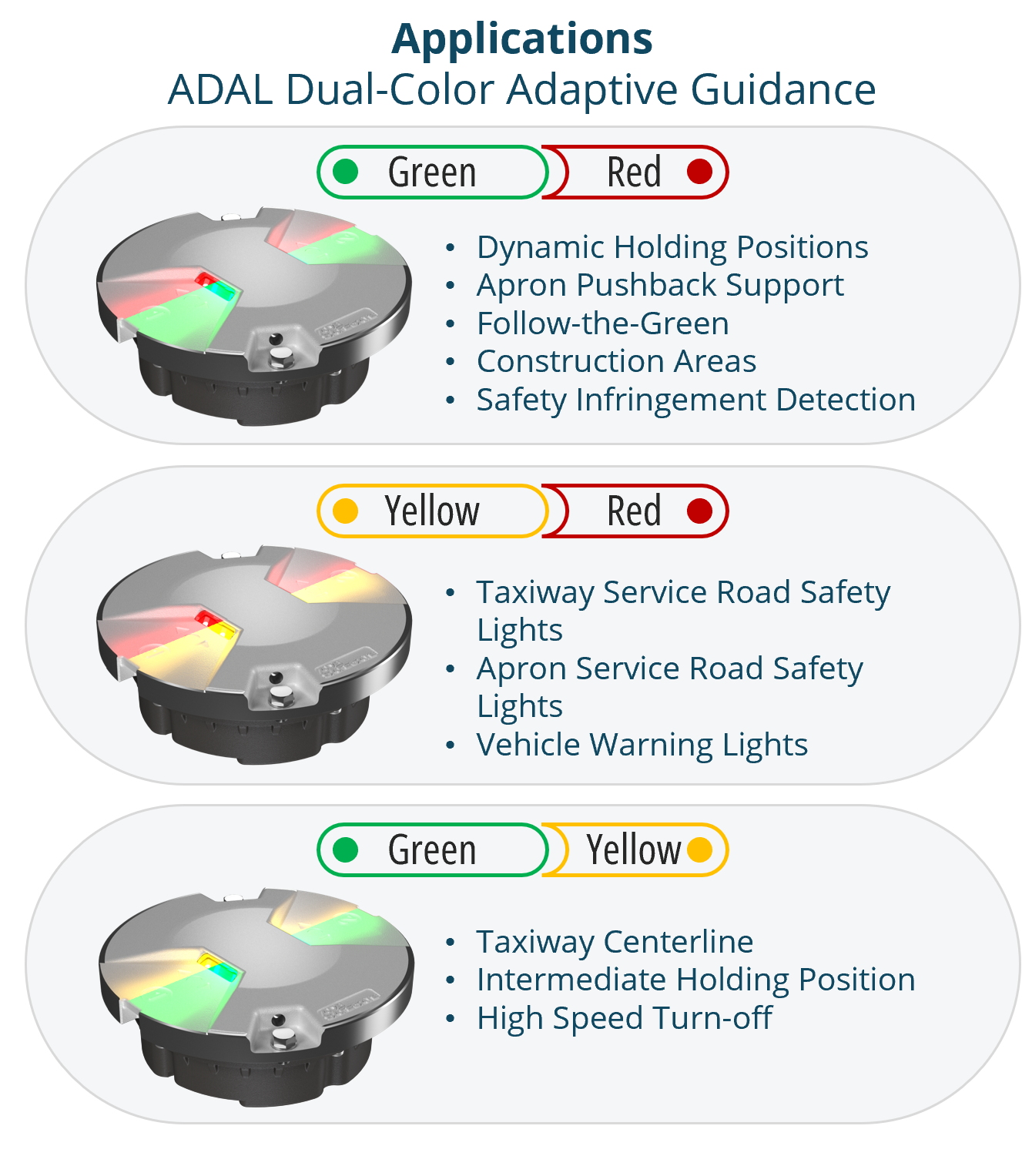
- Adaptive inset light with switchable colors
- Dual-color switching controlled via intelligent powerline carrier communications (LINC 360)
- Integrated smart sensors, expanding what the fixture can monitor and report
- Designed for multi-application use and aligned with key compliance standards (including ICAO Annex 14 Vol. 1, FAA AC 150/5345-46, IEC 61827, EASA CS ADR DSN and others)
What Comes Next
The Service Road Safety System is about protecting aircraft from vehicle conflicts at service road crossings, but the bigger story is what adaptive lighting makes possible: a future where airport movement areas are guided by real-time, system-driven visual instructions, not static signage and best-effort coordination.
In the coming Safe Ground Movement Control Use Case Series, ADB SAFEGATE will expand on where else “lights that think” can change ground operations. But the premise is already clear: when surveillance can “see” a risk developing, and lighting can “speak” directly to drivers and flight crews, airports gain an extra layer of safety, right where the hazard actually happens.
If you’d like to explore how the use case maps for your apron and taxiway layout, service road topology, and surveillance environment, contact ADB SAFEGATE to review a concept of operations and deployment approach for automated service road protection.
References
1. EUROCONTROL, Operational Concept and Requirements for Airport Surface Safety Nets, EEC Technical/Scientific Report No. 2010 008.