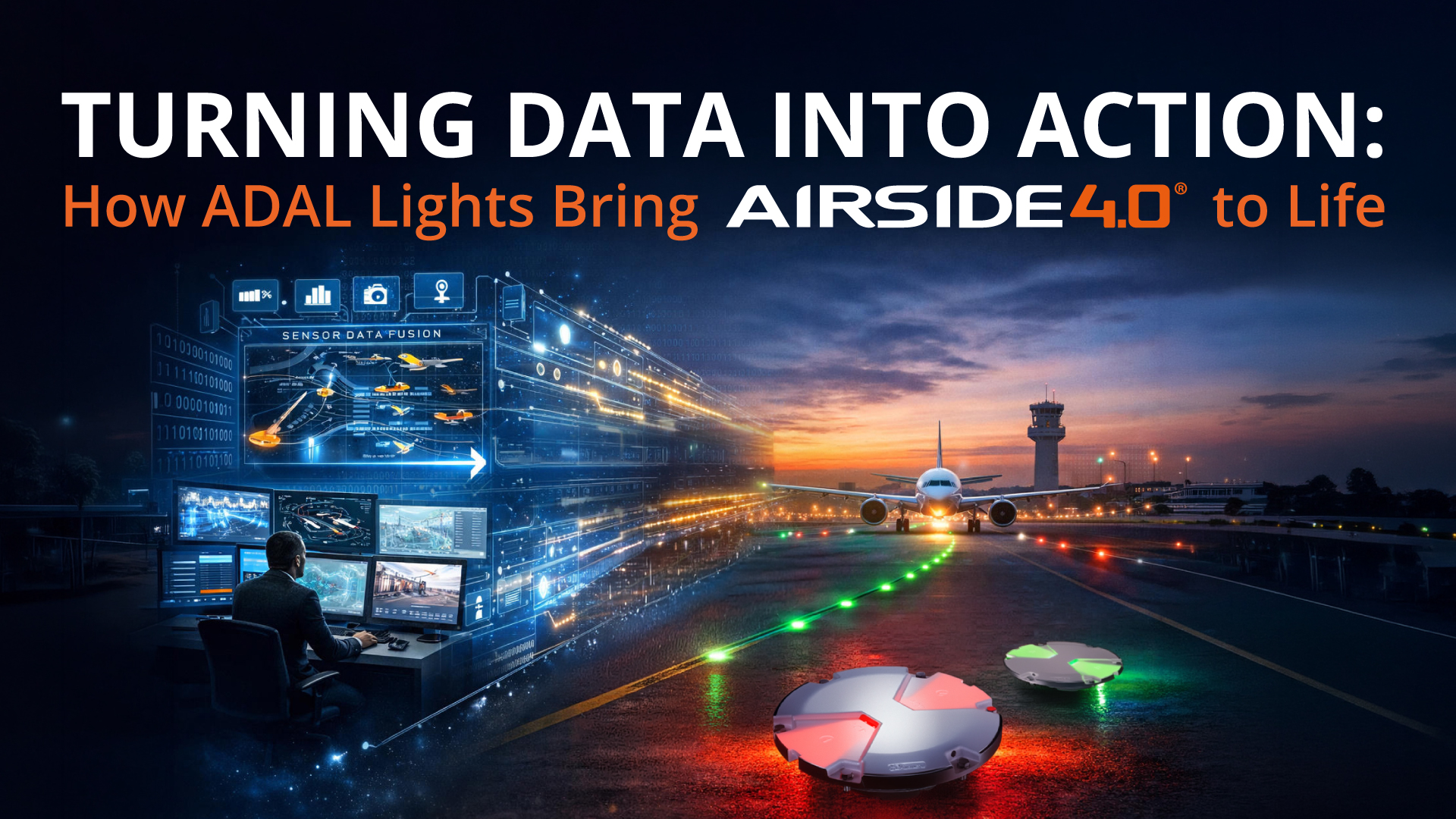
But there’s a critical question at the heart of this vision: What actually turns data into action on the airside? Our newly launched Adaptive Airfield Light (ADAL) provides a clear answer.
Beyond Awareness: From Data to Physical Action
Airside operations already generate vast amounts of data; surveillance systems, vehicle tracking, and movement monitoring continuously build a detailed picture of what’s happening on the ground.
Traditionally, this data is displayed on screens. Controllers interpret it. Instructions are issued. Humans act. But every step introduces delay, interpretation, and the potential for missed signals. ADAL changes this dynamic.
By integrating directly with surveillance systems, ADAL lights convert real-time data into immediate, physical action on the airfield. The light itself becomes an actuator – not just informing users but actively influencing behavior in the moment. This is a fundamental shift:
- From information → human response
- To data → immediate operational action
A New Layer in the Safety Net
Airside safety has always relied on multiple layers of protection – procedures, training, technology, and human oversight. This is often described through the Swiss Cheese Model, where each layer reduces risk, but gaps can still align.
ADAL introduces a powerful new layer. Instead of relying solely on human interpretation of alerts on a screen, ADAL provides direct, unambiguous visual cues exactly where the action is happening.
- A driver doesn’t need to interpret a warning – they see it instantly in their environment
- A pilot doesn’t rely only on radio – they receive intuitive guidance on the ground
This creates an additional, independent safety barrier, one that operates in real time and at the point of execution.
Supporting Higher Safety Integrity Thinking
In safety-critical environments, we often think in terms of Safety Integrity Levels (SIL) – ensuring that systems don’t just detect risks but help prevent them reliably. While many systems today are excellent at detecting and displaying hazards, fewer are capable of directly enforcing or influencing safe behavior. This is where ADAL stands out. As a connected, adaptive lighting system:
- It is driven by validated surveillance data
- It provides consistent, immediate outputs
- It reduces reliance on human reaction time alone
Most importantly, it is one of the few actuators on the airside capable of turning safety logic into a physical, visible action – closing the loop between detection and response.
One Safety Objective across all Use Cases
Across all use cases, the principle is the same: make the right action the obvious action.
ADAL delivers this added safety layer across key operational scenarios:
- Service Road Safety: Aircraft-proximity data drives ADAL road lights: YELLOW caution and RED stop; protecting drivers/aircraft, cutting delays, fuel, and manual control.
- Dynamic Holding Positions: Real-time position data turns centerline ADAL: GREEN go and RED hold; clear, adaptive instructions in all visibility, reducing miscommunication and runway/taxiway risk.
- Apron Pushback Support: Pushback status and apron data trigger ADAL: GREEN “go”, RED “violation”, faster turnarounds, safer crews, less fuel burn.
- Follow-the-Green: Route-clearance data paints surfaces: GREEN active path, RED hold / blocked; unambiguous guidance at intersections, improving taxi efficiency and safety in LVO.
Enabling Safe Ground Movement and Control
ADAL plays a central role in our Safe Ground Movement and Control innovation track.
By translating surveillance data into real-time visual guidance:
- It enhances shared situational awareness
- It reduces ambiguity in fast-moving environments
- It strengthens safety barriers without increasing workload
It ensures that safety is not just monitored – but actively supported on the ground.
Advanced Maintenance: Data Working Twice
ADAL also contributes to our Advanced Maintenance track by leveraging the same data-driven approach. Through sensor data fusion:
- Each light continuously reports its status
- Performance trends can be analyzed in real time
- Maintenance becomes predictive rather than reactive
In this way, data doesn’t just drive operations – it also ensures the infrastructure behind those operations remains reliable and resilient.
Doing More with Less – Without Compromise
Airside 4.0® is not about adding complexity – it’s about using data more effectively.
With ADAL:
- Safety is strengthened through additional, independent layers
- Operational efficiency improves without added infrastructure
- Human workload is supported, not increased
By acting as the bridge between digital intelligence and physical action, ADAL demonstrates how airports can truly do more with less – without compromising safety.
The Future Is Adaptive – and Action-Oriented
The introduction of Adaptive Airfield Lighting marks a shift from passive systems to responsive, safety-driven infrastructure. Because in the airside of the future, it’s not enough to know what’s happening. You need systems that act on it – instantly, reliably, when and where it matters most.